
By Jude Anderson September 26, 2026
For restaurants comparing card entry method processing cost restaurant data, properly tapped or dipped payments usually preserve the strongest card-present transaction data. Fallback swipe and manual key entry can change interchange qualification, fraud exposure, or processor pricing. The exact dollar difference varies by card and contract, so operators should measure fallback and keyed activity and eliminate avoidable exceptions.
| Entry Method | Typical Restaurant Use | Data Quality / Authentication | Qualification Risk | Operational Priority |
| Contactless tap | Normal in-person sale | Strong EMV data | Low when processed correctly | Preferred |
| EMV dip | Normal in-person sale | Strong EMV data | Low when processed correctly | Preferred |
| Magstripe fallback | Chip cannot be completed and fallback is permitted | Exception path; weaker than EMV | Higher | Investigate |
| Manual key entry | Card cannot be read or legitimate special workflow | No normal chip/contactless authentication | Higher | Minimize |
The important distinction is that the entry method affects transaction data and potential interchange qualification, but it does not single-handedly determine what a restaurant pays. Card product, debit versus credit, authorization data, merchant category, settlement timing, processor markup, network assessments, and downgrade conditions can all matter.
For managers comparing card entry method processing cost restaurant data, the useful question is therefore not, “What is the tap rate?” It is: What transactions are leaving our normal EMV path, why are they doing it, and what are those exceptions actually costing us?
The Entry-Method Hierarchy in a Restaurant
In a properly configured restaurant POS environment, the practical hierarchy is usually:
- Contactless tap.
- EMV chip insertion.
- Valid magstripe fallback where permitted.
- Manual key entry as an exception.
Tap and dip sit at the top because both can be EMV card-present transactions. EMVCo reports that EMV chip technology now accounts for the overwhelming majority of global card-present transactions, reflecting how firmly chip-based authentication has become the normal acceptance path.
Magstripe fallback is different. It is an exception used when an attempted chip transaction cannot be completed and the applicable terminal, network, acquirer, and regional rules permit a fallback path.
Visa’s official implementation guidance explains how magnetic-stripe and manual-entry fallback transactions are identified, including POS entry-mode and terminal-capability data that allow acquirers to distinguish fallback from ordinary magnetic-stripe or manually entered transactions.
It also characterizes manual key entry as a last-resort path when chip and magnetic-stripe reading cannot be completed.
That means a bartender should not treat “swipe it instead” or “just type the number” as a faster alternative whenever the chip reader feels inconvenient.
The entry method is only one part of the cost equation. The customer’s card product can materially change the underlying economics as well, so restaurants comparing keyed, dipped, and tapped transactions should also understand how card type affects transaction costs.
The useful comparison is the complete transaction profile—card type, restaurant interchange entry mode, qualification, and processor markup—not the terminal action in isolation. This is especially important when evaluating card entry method processing cost restaurant reports across locations or terminals.
Tap vs Dip: Usually the Same Operational Goal, Not a Simple Rate Contest
Bars sometimes search for tap to pay rates bar expecting to find a special lower contactless percentage. That is usually the wrong way to analyze the transaction.
Both contactless tap and chip insertion can produce EMV card-present transactions. Mastercard explains that a chip communicates with the terminal to establish card authenticity whether the card is inserted or, where supported, tapped.
Contactless has an operational advantage: the physical chip does not have to be inserted into a reader, reducing dependence on clean electrical contacts and potentially reducing wear on the insertion slot.
But that does not establish a universal interchange savings for tap over dip.
Two $60 restaurant transactions can both be correctly processed as card-present EMV transactions and still have different interchanges because one customer uses a premium rewards credit card while another uses a regulated debit card.
Visa itself distinguishes interchange reimbursement from the merchant’s overall discount rate. Visa explains that interchange is paid between acquiring and issuing institutions, while merchants negotiate a merchant discount or processing price with their financial institution.
That distinction matters throughout any discussion of keyed vs chip transaction fees. It also explains why a search for a tap to pay rate bar cannot be answered accurately with one fixed percentage: the entry method is only one component of the transaction’s overall cost.
Why Keyed Restaurant Transactions Can Cost More Than Chip or Contactless
A manually entered PAN lacks the normal chip or contactless transaction data created when the payment credential interacts with an EMV terminal.
Physical presence does not change that.
If a diner is standing at the bar while an employee types the card number into a POS screen, the payment has not magically gained the same authentication characteristics as a chip transaction.
Depending on the network, card product, processor configuration, and message data, manual entry can produce:
- Different interchange qualification.
- More limited authentication information.
- Greater fraud exposure.
- Different processor risk treatment.
- Additional processor charges under some merchant agreements.
- More complicated dispute evidence.
That does not mean every keyed transaction is assigned one universal “keyed rate.” Current Visa interchange schedules, for example, contain numerous categories differentiated by card product, merchant environment, qualification, and transaction characteristics rather than one single percentage for all manual transactions.
A processor could also impose its own pricing treatment on keyed transactions. That charge is processor markup, not automatically a Visa or Mastercard interchange penalty.
For that reason, restaurants reviewing keyed vs chip transaction fees should separate a true interchange qualification difference from any additional processor-specific keyed pricing. Combining the two can make the cost of manual entry look simpler than it actually is.
Legitimate Keying vs Avoidable Keying
Manual entry is not inherently evidence that an employee has done something wrong.
A restaurant may have legitimate card-not-present activity such as telephone takeout orders, catering payments, or certain reservation transactions.
The management problem is avoidable manual entry during an otherwise in-person card-present checkout.
Those two populations should be measured separately.
This separation also makes card entry method processing cost restaurant analysis more useful. Legitimate phone-order activity should not inflate the metric used to judge whether bartenders are unnecessarily keying cards at functioning terminals.
What Can the Same $60 Tab Cost Under Different Entry Methods?

Illustrative example — not a Visa, Mastercard, processor, or universal network rate.
Assume a restaurant has reviewed its own transaction-level processing data and determined that:
- Proper tap/dip transactions establish its comparison baseline.
- Valid fallback transactions average 20 basis points plus $0.05 more than the applicable properly qualified card-present comparison.
- Avoidable keyed transactions average 45 basis points plus $0.10 more.
- Dip and tap produce no measurable incremental difference for this particular analysis.
Those assumptions are deliberately hypothetical.
The formula is:
Extra cost = $60 × incremental percentage + incremental per-item charge
For fallback:
$60 × 0.20% + $0.05 = $0.12 + $0.05 = $0.17
For keyed:
$60 × 0.45% + $0.10 = $0.27 + $0.10 = $0.37
| Entry Method | Tab Amount | Illustrative Incremental Cost | Why |
| Tap | $60 | Baseline | Proper EMV/contactless path |
| Dip | $60 | $0.00 vs baseline in this example | Proper EMV chip path |
| Fallback swipe | $60 | $0.17 | Hypothetical qualification/pricing difference |
| Manual key | $60 | $0.37 | Hypothetical manual-entry qualification/pricing difference |
Do not copy these figures into a restaurant budget without validating them against actual processing data.
The useful lesson is the math: a difference that looks small at one table can become material across thousands of transactions. That is why keyed vs chip transaction fees are best evaluated using the restaurant’s own transaction mix rather than a generic online rate comparison.
Why Bars and Restaurants End Up Keying Cards
Worn or Damaged Cards
A damaged chip or contactless antenna can legitimately fail.
Staff should follow the POS-approved retry and fallback sequence rather than immediately typing the PAN.
Dirty or Damaged Chip Readers
When several unrelated cards fail at one terminal, the reader deserves suspicion.
A bartender may blame customers’ cards when the actual problem is contamination, worn contacts, damaged hardware, outdated firmware, or an incorrect terminal configuration.
Busy-Night Shortcuts
Rush periods create bad habits.
A bartender who learns that manual entry appears to “work faster” than troubleshooting a failing reader can turn an isolated hardware problem into hundreds of keyed transactions.
Bar Tabs and Walkouts
Bar tabs deserve a properly designed hospitality workflow, not improvised card-number handling.
A compliant POS should use appropriate preauthorization, tokenization, subsequent authorization functionality where supported, and final closeout processes.
Do not write card numbers on paper, maintain a spreadsheet of PANs, or save security codes for possible walkouts.
PCI SSC states unequivocally that card verification codes such as CVV2/CVC2/CID cannot be retained after authorization—even for card-on-file or recurring use, even if encrypted, and even with customer permission.
Phone Orders or True Card-Not-Present Transactions
A legitimate telephone order is not a failed card-present transaction.
Process it through the approved MOTO/card-not-present workflow rather than manipulating the entry mode to make it appear card-present.
POS or Reader Failure
If manual entry rises suddenly across one terminal, one location, or immediately after a deployment, inspect the equipment before blaming employee discipline.
The restaurant’s restaurant interchange entry mode reporting can help determine whether those failures are isolated exceptions or a recurring operational pattern.
What Fallback Swipe Means — and Why Repeated Fallback Is a Warning Sign
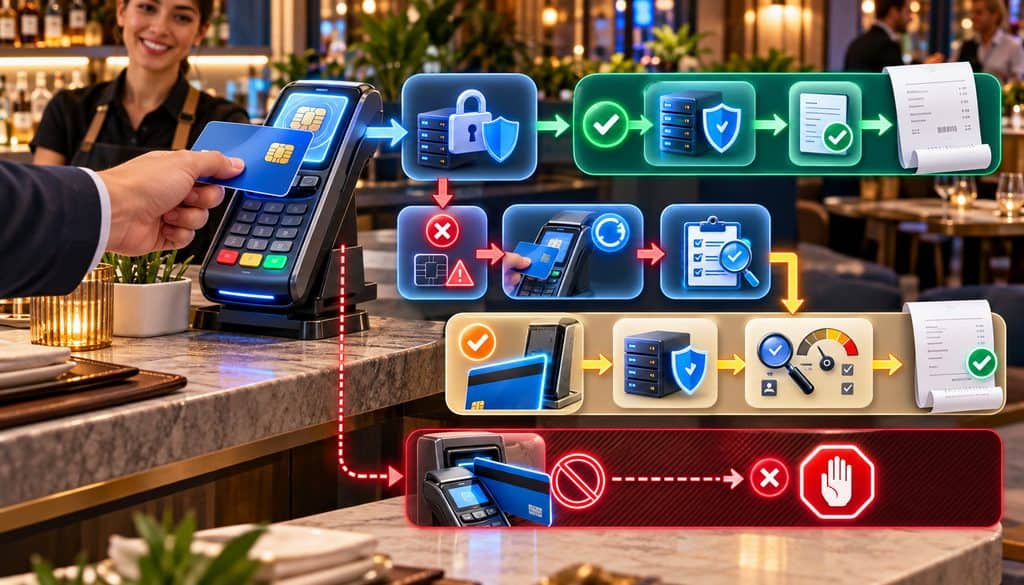
EMV fallback does not simply mean “someone swiped a card.”
It refers to an attempted chip transaction that cannot be completed and subsequently moves to another permitted acceptance path.
Visa’s device guidance calls for chip retries before magnetic-stripe fallback, online authorization, and data identifying the transaction as fallback. Manual entry is described as a further last-resort option when magnetic-stripe reading is unavailable, subject to applicable rules.
So a fallback swipe downgrade should not be treated as a universal fixed fee. The actual consequence depends on network rules, transaction qualification, liability conditions, and processor pricing.
One genuine damaged-card incident is operationally different from 9% of transactions on Terminal 4 falling back every Friday night.
| Pattern | Likely Cause | What to Check |
| Many cards fail on one terminal | Reader problem | Clean, reboot, update, test, replace |
| Same card fails on several terminals | Customer card issue | Approved alternate payment method |
| Failures spike during rush periods | Staff workflow | Training and reader placement |
| High fallback at one location | Configuration or hardware | Terminal logs and POS configuration |
| Keyed rate rises after deployment | Device/setup issue | Installation, firmware, configuration |
A recurring fallback swipe downgrade pattern should therefore trigger investigation rather than acceptance as a normal cost of doing business. Managers should determine whether the root cause is the card, reader, software configuration, or staff behavior.
When Persistent Chip-Read Failure Means the Terminal, Not the Card, Is the Problem
Treat reader health as measurable operational data.
Warning signs include:
- Multiple unrelated cards failing on the same terminal.
- One device showing substantially more fallback than neighboring devices.
- Failures beginning after a firmware, POS, or hardware change.
- Contactless working while chip insertion repeatedly fails.
- Frequent remove-and-reinsert cycles.
- Known-good cards succeeding on other terminals.
Use a controlled diagnostic process:
- Clean the reader according to the manufacturer’s instructions.
- Restart the terminal.
- Verify network connectivity.
- Confirm supported software and firmware versions.
- Review terminal error logs.
- Test known-good cards through approved procedures.
- Compare failure rates across devices.
- Escalate persistent failures to the POS/payment provider.
- Replace defective equipment where appropriate.
Do not make routine EMV bypass the “fix.”
From a card entry method processing cost restaurant perspective, a failing terminal is not just a maintenance problem. If the reader continually pushes otherwise valid card-present transactions into fallback or manual entry, it can also distort qualification and processing-cost data.
How Tip Adjustment Interacts With Entry Method
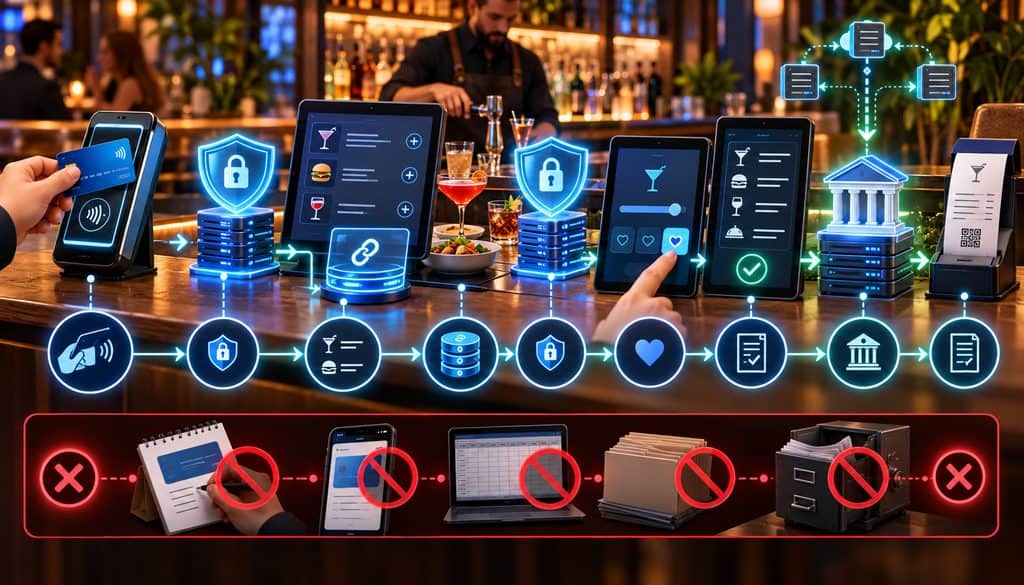
Restaurant tip processing requires more precision than “tips cause downgrades.”
There are several separate stages:
| Stage | Restaurant Action | Payment-System Purpose |
| Card presented | Tap/dip or other valid entry method | Authenticate and request authorization |
| Tab opened | Estimated/preauthorization where supported | Establish approved amount |
| Additional spend | Incremental authorization where applicable | Increase authorized amount |
| Tip entered | Final gratuity captured | Establish final transaction amount |
| Settlement | Final amount submitted | Complete clearing |
A restaurant’s final cleared amount can legitimately differ from the initial authorization, but the permitted process depends on network rules, entry method, cardholder-verification method, authorization type, merchant category, and geography.
Mastercard’s U.S. Transaction Processing Rules for restaurant gratuities distinguish among contactless, Chip/PIN, card-not-present, key-entered, magnetic-stripe, and qualifying signature-chip transactions. For specified qualifying transactions, the rules address when gratuity may be added after authorization and when an incremental authorization is required.
Other qualifying U.S. restaurant card-present transactions—including certain signature chip, magnetic-stripe, and key-entered transactions—may add gratuity after authorization under specified conditions; the current U.S. rule provides a 30% tolerance for those qualifying cases and permits incremental authorization above that threshold when the original authorization was a preauthorization.
That is precisely why operators should not build a universal “20% tip rule” or “30% tip rule” into staff training without considering network and transaction type.
Visa’s restaurant guidance historically describes a tip allowance of up to 20% for certain restaurant MCCs, while Visa’s more recent authorization guidance emphasizes estimated and incremental authorization as mechanisms for transactions in which the final amount is not yet known.
For operators investigating tip adjust keyed transactions, the useful operational conclusion is therefore narrower: manual entry plus later adjustment can carry different transaction characteristics from a properly authenticated EMV payment, and large increases should follow the POS/acquirer’s current network-compliant authorization workflow.
The phrase tip adjust keyed transactions should not be interpreted as meaning that every keyed payment with a gratuity automatically downgrades. Authorization method, final amount, entry mode, network rules, and transaction data all matter.
Bar Tabs Should Use Preauthorization, Not Manual Card Entry Workarounds
A proper bar-tab design should support the sequence the payment ecosystem expects.
Visa describes estimated authorization as an authorization used when the final purchase amount is not yet known and incremental authorization as a way to increase secured funds as the amount grows. Visa also notes that the initial estimated or initial authorization establishes important final transaction characteristics.
A modern hospitality workflow may therefore involve:
- Card-present initial authorization.
- Tokenized credential handling.
- Estimated or preauthorized amount.
- Incremental authorization where supported and necessary.
- Final gratuity capture.
- Proper closeout and clearing.
- Approved walkout procedures.
Do not substitute:
- Written-down PANs.
- Saved CVV values.
- Shadow spreadsheets.
- Screenshots of card information.
- Routine manual PAN entry.
PCI SSC’s current guidance also says sensitive authentication data remains prohibited from storage after authorization regardless of whether a PAN is retained.
The payment-entry decision also affects what evidence exists if a customer later disputes the charge. Restaurants with open tabs should therefore combine secure authorization workflows with a documented bar and restaurant chargeback-prevention process covering receipts, tab closeout, transaction records, refunds, and dispute evidence.
How to Measure Your Restaurant’s Keyed-Entry Percentage
Managers need a denominator before they need a target.
- Pull one complete month of transaction-level POS or gateway data.
- Export entry mode when the system exposes it.
- Separate transactions into contactless, chip, magnetic stripe, fallback, manual/keyed, card-not-present, and unknown.
- Identify legitimate phone-order, delivery, online, and catering channels.
- Calculate avoidable in-person manual activity using:
Keyed-entry percentage = manually keyed card-present attempts ÷ eligible in-person card transactions × 100
- Compare the result by location, terminal, employee, shift, and daypart.
- Investigate outliers.
- Establish a reduction target based on your own legitimate exception volume.
Do not assume an internet article’s “acceptable keyed percentage” applies to your restaurant.
For stronger card entry method processing cost restaurant analysis, pair this percentage with transaction volume and actual cost data. A terminal with a relatively small keyed share can still deserve attention if it processes a very large number of transactions.
Entry-Mode Scorecard
| Metric | Current Month | Prior Month | Target / Investigation Trigger |
| Contactless share | Site-specific | ||
| EMV dip share | Site-specific | ||
| Manual keyed share | Site-specific | ||
| Fallback share | Site-specific | ||
| Unknown entry mode | Investigate | ||
| Chip-read failure incidents | Site-specific |
Finding Keyed Activity on Your Statement
Processor statements are inconsistent.
Depending on the provider, you may see clues such as:
- Card-present/card-not-present distinctions.
- Qualification categories.
- Downgrade descriptions.
- Keyed counts.
- Interchange categories.
- Entry-mode indicators.
But statements often aggregate transactions.
Your POS, gateway, or processor export is usually more useful for terminal-level diagnosis.
Ask your processor:
“Can you provide transaction-level entry mode or interchange qualification data for manual, EMV, contactless, and fallback transactions?”
When reviewing the response, look specifically for restaurant interchange entry mode information that lets you connect a transaction’s acceptance method with its qualification category. That is more useful than relying solely on a statement’s summarized fee totals.
How to Calculate What Avoidable Keyed Transactions Cost Each Month
The simplest estimate is:
Monthly avoidable cost = avoidable keyed transactions × average incremental cost per keyed transaction
The stronger method is:
Monthly incremental cost = sum of each keyed transaction’s actual processing cost minus the estimated cost under its correct card-present qualification
That second calculation requires transaction-level pricing data and careful matching because card products differ.
Using the earlier hypothetical $0.37 incremental keyed cost:
- Avoidable keyed transactions: 400/month.
- Average ticket: $60.
- Monthly keyed volume: 400 × $60 = $24,000.
- Estimated monthly excess: 400 × $0.37 = $148.
- Estimated annual excess: $148 × 12 = $1,776.
Again, the $0.37 assumption is illustrative—not a network rule.
This calculation gives management a much more useful card entry method processing cost restaurant figure than simply comparing a processor’s advertised rate. It isolates the operational cost associated with avoidable keyed activity while acknowledging that the precise difference varies transaction by transaction.
Processor Pricing Model Matters
Interchange-Plus
Qualification changes may be easier to see because underlying interchange and processor markup are generally separated.
This can make differences associated with restaurant interchange entry mode more visible when the statement or transaction export provides sufficient detail.
Flat-Rate
A merchant might pay the same advertised retail percentage on several transaction types even when the provider’s underlying economics differ.
That can hide the practical difference between keyed vs chip transaction fees from the merchant, even though the provider’s underlying transaction economics may differ.
Tiered or Bundled
Keyed or downgraded activity may be mapped into more expensive pricing buckets, depending on the contract.
Subscription or Membership Pricing
Changing processor markup does not eliminate underlying interchange differences.
No pricing model guarantees that keyed transactions become harmless.
Card-Present vs True Card-Not-Present
A restaurant can simultaneously operate several legitimate channels:
- Dining room.
- Bar.
- Phone orders.
- Online ordering.
- Delivery.
- Catering invoices.
- Stored-card reservations.
Do not mix all manually handled transactions into one performance metric.
A telephone order legitimately processed as card-not-present is not an FOH failure.
A bartender typing a customer’s card number while that customer is standing beside a functioning terminal is a different issue.
That distinction makes restaurant POS reporting significantly more useful and keeps card entry method processing cost restaurant measurements from being distorted by legitimate CNP transactions.
How to Reduce Keyed and Fallback Transactions Without Slowing Service
Reader Placement
Place terminals where customers and staff can tap or insert naturally rather than stretching cables, twisting screens, or passing cards across a crowded station.
Make Tap Easy
Where supported, keep contactless enabled, visible, and operational.
The goal is not to chase a supposedly universal tap to pay rates bar advantage. It is to keep normal in-person payments on a properly authenticated card-present path whenever the card and terminal support it.
Require Retry Before Manual Entry
A reasonable workflow is:
- Retry the approved tap/chip sequence.
- Use another functioning reader if appropriate.
- Follow the POS-approved fallback process where permitted.
- Key manually only when the authorized exception workflow applies.
Restrict Manual Entry
Where the POS supports permissions, consider manager approval or role-based access for manual PAN entry.
Train for Rush Periods
Busy service is when shortcuts become normalized.
Use Proper Bar-Tab Functions
Use tokenized preauthorization and supported authorization workflows rather than creating informal card-on-file practices.
Monitor Reader Health
Flag terminals generating unusually high chip failure or fallback activity.
Review Entry Modes Weekly
A weekly terminal-level report can identify a damaged reader before manual entry becomes standard behavior.
It can also show whether a recurring fallback swipe downgrade issue is concentrated on a particular terminal, employee, or shift rather than being a restaurant-wide problem.
Is It a Staff Problem or Hardware Problem?
| Symptom | Likely Staff Issue | Likely Hardware Issue | Next Step |
| One employee has high keyed activity | High | Low | Coaching/review |
| One terminal has high fallback | Low | High | Diagnose device |
| All terminals rise after POS change | Medium | Medium | Review deployment/configuration |
| Keying spikes only during rush | High | Medium | Workflow review |
| Chip failures persist all day | Low | High | Hardware escalation |
Three Restaurant Examples
Example 1 — Nightclub With High Manual Entry
A nightclub discovers one service-well terminal produces three times the manual-entry activity of every other terminal.
Review shows unrelated cards repeatedly failing chip insertion. The reader is replaced, and the keyed anomaly largely disappears.
The problem was visible only after management compared entry mode by device rather than lecturing every bartender.
This is exactly the kind of device-level issue that broad card entry method processing cost restaurant reporting can expose before unnecessary manual entry becomes routine.
Example 2 — Restaurant With a Healthy Tap/Dip Mix
A restaurant sees that most dining-room payments are contactless or chip, while telephone takeout orders remain card-not-present.
Management separates those legitimate CNP payments from FOH keying rather than setting a meaningless “zero keyed transactions” target.
That distinction also prevents legitimate phone orders from making keyed vs chip transaction fees appear worse than the actual in-person operating problem.
Example 3 — Busy Bar Keying Cards for Walkouts
Staff members are manually re-entering card information when tabs are not properly closed.
Management discovers that the POS already supports a tokenized tab/preauthorization workflow.
The fix is workflow configuration and training—not saving card details more aggressively.
Frequently Asked Questions
Is tap cheaper than chip for restaurants?
Not universally. Proper tap and dip transactions can both be EMV card-present transactions. Differences in card type, qualification, restaurant interchange entry mode, and processor pricing matter more than simply whether the customer tapped or inserted.
That is why searches for tap to pay rates bar should not be interpreted as evidence that contactless has one universal lower rate.
How much more does a keyed restaurant transaction cost?
There is no single amount. Use transaction-level processor data to compare your keyed activity with equivalent properly qualified card-present transactions. The $60 example above shows how to evaluate keyed vs chip transaction fees without presenting a fake universal network rate.
Does swiping after a chip failure cause a downgrade?
It can affect qualification, risk, or liability treatment, but valid fallback is not identical to arbitrary swiping. A genuine fallback follows a failed EMV attempt and applicable network/acquirer procedures. A fallback swipe downgrade therefore cannot be reduced to one universal penalty that applies to every restaurant and every card.
Why do keyed transactions often cost more?
They can lack normal EMV authentication data, carry different fraud characteristics, qualify differently at interchange, or trigger processor-specific pricing.
Does adding a tip increase the interchange rate?
Not automatically. The relevant issue is whether authorization and final clearing follow the applicable network requirements for that entry method, authorization type, MCC, and tip amount.
Restaurants researching tip adjust keyed transactions should therefore focus on the complete authorization and settlement workflow rather than assuming that the tip itself automatically creates a downgrade.
How do I find keyed transactions in my POS reports?
Export transaction-level data and look for entry-mode fields covering chip, contactless, magnetic stripe, fallback, keyed/manual, and CNP.
If the POS lacks the fields, ask the gateway or processor for transaction-level entry-mode data. Ideally, the export should also provide enough restaurant interchange entry mode detail to compare acceptance method with qualification.
What keyed-entry percentage should a restaurant target?
There is no reliable universal target. Establish your own baseline after removing legitimate CNP channels, then investigate avoidable manual transactions by terminal, employee, location, and shift.
Should staff ever manually key a card?
Some legitimate workflows can require manual entry, subject to processor and network rules. Routine manual keying should not replace working EMV acceptance.
How do I know whether the terminal is causing chip failures?
Compare multiple cards and multiple terminals. If unrelated cards fail on one device but work elsewhere, or failure increases after a hardware or firmware change, escalate the terminal rather than normalizing fallback.
The Operational Bottom Line
Understanding card entry method processing cost restaurant data is less about finding a mythical “tap rate” and more about controlling exceptions.
Contactless and chip should handle normal in-person restaurant payments. Fallback should remain a genuine exception. Manual entry should have a legitimate reason.
Measure entry mode by terminal, employee, location, and channel; separate true card-not-present business from avoidable FOH keying; calculate incremental costs using actual processor data; and investigate concentrated failure patterns.
Restaurants should also treat keyed vs chip transaction fees, fallback swipe downgrade activity, restaurant interchange entry mode reporting, and tip adjust keyed transactions as related diagnostic signals rather than isolated pricing terms.
That approach improves more than pricing. It also helps preserve stronger payment authentication, cleaner authorization data, better bar-tab handling, and a checkout process that does not depend on insecure shortcuts.