By Petrik Parkar March 24, 2026
Running a business in the United States is becoming more expensive every year. From rent and payroll to inventory and insurance, costs continue to rise. However, one of the most overlooked expenses is credit card processing fees. Many merchants do not realize they are losing thousands of dollars annually just by accepting card payments.
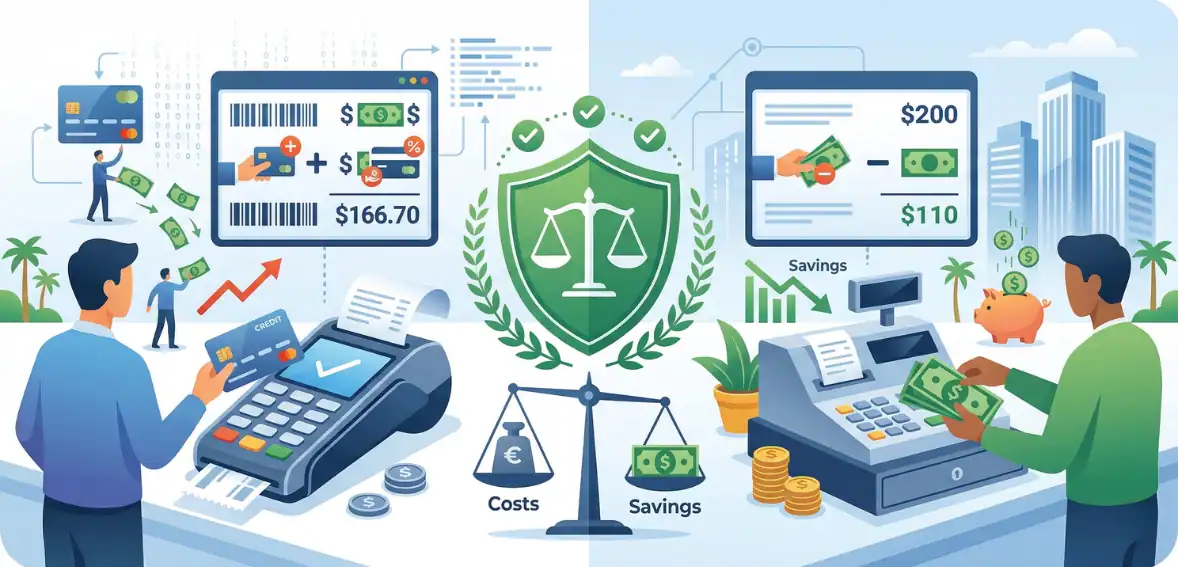
Every time a customer pays with a credit card, the merchant pays a percentage of that sale. While this may seem small per transaction, the total cost over months and years can significantly reduce profits. This is why many businesses are now exploring legal strategies, such as surcharging credit cards legally and implementing a cash discount program merchant strategy to reduce transaction fees.
These pricing programs are not shortcuts or loopholes. They are recognized pricing models that allow merchants to recover payment costs transparently and legally. When properly implemented, they help businesses maintain profitability without raising prices across the board.
Understanding how these programs work is essential because incorrect implementation can create compliance risks. But when done correctly, they can become one of the smartest financial decisions a business makes.
Table of Contents
Understanding Why Credit Card Processing Fees Are Increasing

Credit card payments have become the preferred payment method for American consumers. While this convenience helps businesses increase sales, it also increases operating costs.
Every credit card transaction involves multiple financial institutions working behind the scenes. Each participant takes a portion of the transaction fee. These parties include the issuing bank, the card network, and the payment processor.
Most merchants pay between 2 percent and 4 percent per transaction. For a business processing $50,000 monthly, this could mean paying $1,000 to $2,000 every month in fees alone. Over a year, that could reach $24,000 or more.
For businesses with thin profit margins, especially restaurants, retail stores, and service providers, these costs can determine whether the business grows or struggles.
Because of this, merchants are no longer simply accepting these costs. They are actively searching for ways to manage them responsibly. Cost recovery programs like surcharging and cash discounting have become popular because they address this challenge directly.
What Is Credit Card Surcharging and Why Businesses Use It
Credit card surcharging is a pricing strategy where a business adds a small fee when a customer chooses to pay with a credit card. This fee helps offset the processing cost the merchant would otherwise pay.
Instead of raising prices for all customers, the merchant only applies the cost to the payment method that creates the expense. This approach is considered fair by many businesses because customers who pay with lower-cost methods like cash are not affected.
For example, if a product costs $100 and the processing cost is 3 percent, the business may charge $103 for credit card payments while keeping the cash price at $100. This allows the business to recover the cost without reducing its profit margin.
Many merchants adopt this approach because it provides pricing transparency. Customers can clearly see the cost difference between payment methods and choose accordingly.
Businesses that implement surcharging often report improved margins, better expense control, and more predictable financial planning.
Legal Rules Businesses Must Follow When Surcharging Credit Cards

While surcharging is legal in most parts of the United States, it must be done according to specific rules. Payment networks like Visa and Mastercard require merchants to follow compliance standards.
These rules exist to protect consumers and ensure transparency. Businesses that ignore these requirements risk penalties or losing their merchant accounts.
Major Compliance Requirements
Businesses must follow several important rules:
• The surcharge can only apply to credit cards.
• Debit cards cannot be surcharged.
• The surcharge must not exceed the actual processing cost.
• Customers must be informed before payment.
• The fee must appear clearly on the receipt.
Merchants must also notify their payment processor and card networks before starting a surcharge program. This is a simple administrative process, but it is required for compliance.
Importance of Clear Customer Disclosure
Transparency is the most important part of compliance. Customers should never feel surprised by pricing. Businesses must display clear signage explaining the surcharge policy at the entrance and at the checkout area.
Proper disclosure builds trust and prevents disputes. Most customers accept surcharges when they understand the reason behind them.
What Is a Cash Discount Program and How It Works
A cash discount program works differently from surcharging, although the financial goal is similar. Instead of adding a fee to card payments, the merchant lists the regular price as the card price and offers a discount to customers who pay with cash.
This approach changes how the pricing is structured but achieves the same financial result.
For example, instead of pricing a product at $100 and adding a surcharge, the business may list the price as $103 and offer a $3 discount for cash payments. This makes the card price the standard price while rewarding customers who choose lower-cost payment methods.
This model is often easier to implement from a compliance perspective because federal law clearly allows cash discounts as a standard pricing practice.
Why Many Merchants Prefer Cash Discount Programs

Many businesses prefer cash discount programs because they are considered simpler from a regulatory standpoint. Unlike surcharging, cash discount programs do not require network registration.
This makes them attractive to merchants who want cost recovery without dealing with additional compliance steps.
Another advantage is customer perception. Customers often react more positively to discounts than fees. Psychologically, a discount feels like a reward, while a fee can feel like a penalty.
Businesses also find that cash discount programs encourage customers to use cash more frequently, which eliminates processing fees entirely for those transactions.
Over time, this shift in payment behavior can significantly reduce overall processing expenses.
Comparing Surcharging and Cash Discount Programs
Although both programs help reduce payment costs, they are structured differently and may suit different types of businesses.
Surcharging works well for businesses where customers primarily use credit cards and are unlikely to switch payment methods. Cash discount programs may work better for businesses with customers who frequently use cash.
The decision often depends on customer demographics, transaction size, and business type.
Businesses that want the most straightforward compliance structure often choose cash discount programs. Businesses focused on direct cost recovery sometimes prefer surcharging.
There is no universal solution. The right choice depends on operational goals and customer behavior.
How These Programs Help Reduce Transaction Fees
The primary reason merchants adopt these programs is simple: they help businesses keep more of their revenue.
When merchants absorb processing fees, they effectively reduce their own profit margins. Over time, this can limit hiring, expansion, and investment opportunities.
By implementing cost recovery strategies, businesses can stabilize their financial structure. Instead of reacting to rising costs, they proactively manage them.
This shift changes payment processing from an uncontrollable expense into a manageable business decision.
Businesses using these programs often report measurable improvements in profitability within months of implementation.
How Proper Implementation Determines Success
The success of these programs depends heavily on how they are introduced and managed. Poor communication or incorrect setup can create confusion.
Successful businesses focus on planning before implementation. They ensure their POS systems are configured correctly, staff are trained, and signage is installed properly.
Merchants that treat implementation as a professional project rather than a quick change typically achieve better results.
Proper setup also ensures smooth customer interactions. When employees can confidently explain pricing policies, customers are less likely to question them.
The Importance of Employee Training
Employees play a major role in how customers perceive these programs. If staff cannot explain pricing clearly, customers may become frustrated.
Training should focus on simple explanations. Staff should be able to explain that processing fees exist and that pricing reflects payment costs.
Employees should also understand compliance basics so they do not accidentally apply fees incorrectly.
When staff understand the program, they communicate with confidence. This improves customer acceptance.
How Customer Communication Affects Acceptance
Communication is one of the biggest factors determining whether these programs succeed. Customers are more accepting when they understand the reason behind pricing changes.
Businesses should focus on transparency rather than technical explanations. Simple messaging works best.
For example, businesses can explain that card companies charge fees, and the program helps keep prices lower overall.
When customers understand that the goal is fairness rather than profit, acceptance increases significantly.
Industries That Benefit the Most From These Programs
Some industries see greater benefits because they process high volumes of card transactions.
Restaurants often benefit because they operate on narrow margins and process many small transactions daily. Retail businesses also benefit because of their high transaction frequency.
Medical offices, automotive repair businesses, and service providers also benefit because their average transaction sizes are higher, making processing fees more significant.
Any business processing large volumes of credit card payments can potentially benefit from these programs.
Common Misconceptions About Surcharging and Cash Discounts
Many businesses hesitate to implement these programs because of misinformation. One common myth is that these programs are illegal. In reality, they are legal when properly structured.
Another misconception is that customers will leave. Research and industry experience show that most customers accept these programs when they are clearly explained.
Some merchants also believe these programs are complicated. Modern payment technology has made implementation easier than ever.
Understanding the facts helps businesses make informed decisions rather than reacting to myths.
Risks Businesses Must Avoid
Like any financial strategy, these programs must be managed carefully. Mistakes usually occur when businesses rush implementation or fail to understand compliance requirements.
The most common mistake is accidentally applying surcharges to debit cards. This is prohibited by card network rules.
Another risk is poor disclosure. Hidden fees damage trust and may create compliance issues.
Working with experienced payment professionals and using compliant technology reduces these risks significantly.
Long-Term Financial Benefits of Cost Recovery Programs
The long-term benefits of these programs often extend beyond immediate savings. Businesses that reduce expenses improve financial stability.
This allows better budgeting, stronger cash flow management, and more confident expansion planning.
Over time, even small percentage savings can create large financial advantages. Businesses can reinvest these savings into marketing, staffing, or equipment.
Cost control is often the difference between businesses that survive and those that grow.
Best Practices for Long-Term Success
Businesses that succeed with these programs treat them as part of a long-term financial strategy rather than a temporary fix.
Regular compliance reviews help ensure programs remain aligned with regulations. Monitoring customer feedback also helps identify communication improvements.
Tracking monthly savings allows businesses to measure impact. Data helps merchants refine strategies over time.
Consistency, transparency, and compliance remain the foundation of successful programs.
The Future of Payment Cost Management
Payment costs are unlikely to decrease. As digital payments increase, managing transaction expenses will become even more important.
More businesses are expected to adopt pricing transparency models. Customers are also becoming more aware of payment economics.
Technology will likely continue simplifying compliance and automation, making these programs even easier to manage.
Businesses that understand payment costs today will be better positioned for tomorrow’s financial environment.
Conclusion
Surcharging and cash discount programs are not just payment strategies. They are financial management tools that help businesses control rising operational costs. By allowing merchants to recover processing expenses legally, these programs create a more sustainable pricing structure.
The key to success lies in proper implementation, clear communication, and ongoing compliance. Businesses that approach these programs professionally often see stronger margins, improved stability, and better long-term financial health. As transaction costs continue rising, smart merchants are choosing proactive strategies rather than accepting unnecessary losses.
FAQs
What is surcharging credit cards legally?
It is the practice of adding a small fee to credit card payments to recover processing costs while following card network rules.
What is a cash discount program merchant strategy?
It is a pricing model where businesses offer a discount to customers paying with cash instead of charging extra fees.
Can these programs really reduce transaction fees?
Yes, they help businesses recover or avoid processing costs, improving overall profitability.
Are customers okay with these programs?
Most customers accept them when pricing is clearly explained and there are no hidden charges.
Which program is better for small businesses?
It depends on customer payment behavior, but both programs can help small businesses control costs.